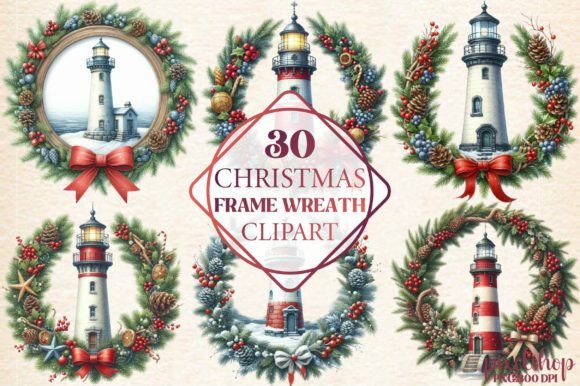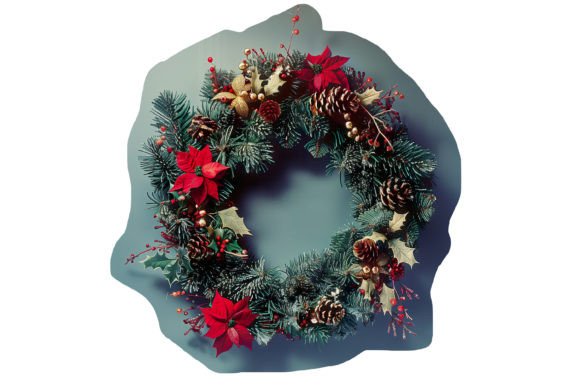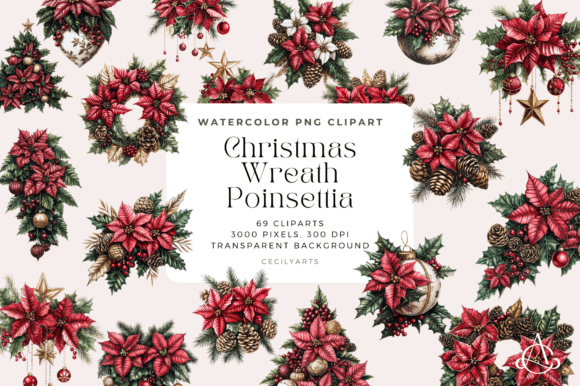
Christmas Wreath Poinsettia Cliparts
As a designer who spends half my life staring at digitized files and the other half wrestling with thread tension, I have learned to trust my gut before I ever hit the start button on my embroidery machine. When a new design lands in my inbox or appears in a marketplace, I am not just looking at a pretty picture; I am visualizing the stitch path, the fabric distortion, and the final product sitting on a customer’s shelf. Today, I want to talk about Christmas Wreath Poinsettia Cliparts, an illustration that screams holiday cheer but requires some serious practical consideration if you plan to turn it into a sellable handmade product.
This is not just another clipart file to slap onto a template. It is a specific aesthetic choice that carries weight. If you are an Etsy seller, a small shop product creator, or a hobbyist looking to make meaningful personalized gifts, understanding how this machine embroidery design translates from screen to fabric is crucial. Let’s break down exactly what works, where it might fail, and how to use Christmas Wreath Poinsettia Cliparts effectively in your real-world projects.
First Impressions: Mood and Visual Personality
The moment you load this embroidery file, the mood is set. It is festive, traditional, and undeniably seasonal. The poinsettia elements provide a bold focal point, while the wreath structure offers a balanced, circular composition that is inherently pleasing to the eye. However, as a reviewer, I look past the initial "wow" factor to see if the design has legs.
The visual personality here is warm and inviting. It feels like something you would hang on a front door or place on a dining table. But does it work when stitched? That depends entirely on how you interpret the illustrations. If the source art is dense with tiny details, you need to be careful. A design assets package labeled as clipart often implies vector-like clarity, but embroidery is additive. You are building texture with thread. Christmas Wreath Poinsettia Cliparts relies on strong shapes—leaves, petals, and stems—to read correctly after stitching. If the lines are too thin or the negative space is cluttered, the design will lose its impact once the stitches pull the fabric tight.
I find that this design naturally belongs to projects that celebrate comfort and tradition. It is not a minimalist piece for a modern corporate logo; it is a statement piece for holiday embroidery focused on home and family.
Real-World Application: Where This Design Shines
Let’s imagine a scenario. It is early November, and you are preparing inventory for the holiday rush. You have a stack of heavy cotton canvas tote bags and some soft fleece sweatshirts. You decide to use Christmas Wreath Poinsettia Cliparts for these items. Here is why it works so well in these contexts:
- Tote Bag Design: The wreath shape fits perfectly on the center panel of a standard tote. The symmetry balances the bag’s structure, and the poinsettias add a pop of color that draws the eye. For an Etsy seller, this is a high-demand item because it serves as both a functional accessory and a seasonal decoration.
- Sweatshirt Embroidery: Heavy fabrics like fleece or thick cotton blends can handle the density of a wreath design without puckering. The warmth of the poinsettia theme pairs beautifully with cozy winter wear. When customers receive a personalized gift like this, they associate the quality of the stitch with the warmth of the garment.
- Kitchen Towels and Tea Towels: This is a classic use case. The vertical orientation of many wreath designs works well on long towels. The durability of the embroidery ensures that the design survives frequent washing, which is critical for kitchen items. It elevates a simple $5 towel into a boutique-quality finished product.
- Baby Embroidery: While poinsettias are bold, a smaller, simplified version of this wreath can look adorable on baby onesies or nursery decor. Just ensure the scale is appropriate. You want the design to feel gentle, not overwhelming, when placed on delicate fabrics.
In each of these cases, the design adds perceived value. A plain tote bag is common; a tote bag with a beautifully stitched wreath feels curated. This distinction is what drives customer trust and encourages repeat business for craft business owners.
Critical Considerations: Where to Exercise Caution
Not every surface is created equal, and Christmas Wreath Poinsettia Cliparts is no exception. There are several scenarios where this design could lead to frustration if you do not plan ahead.
First, consider hoop size limitations. If you are attempting to embroider a large wreath on a small hoop, you may run into issues with repositioning or alignment. Ensure your stitch density is manageable for your machine. High-density fill stitches can cause fabric distortion, especially on lighter materials.
Second, think about fabric texture. Embroidering on highly textured fabrics like bouclé or loose-weave linen can hide the details of the poinsettia petals. The thread might get lost in the weave, resulting in a muddy appearance. Similarly, stretchy fabrics require a sturdy stabilizer to prevent the wreath from warping during stitching. Without proper support, your beautiful circle might turn into an oval.
Third, avoid placing this design on curved surfaces like baseball caps unless you are using a specialized cap frame and have tested the design extensively. The curvature can distort the symmetry of the wreath, making the poinsettias look skewed. Additionally, be wary of dark fabrics. If the design relies on light thread colors for detail, it may lack contrast against a black or navy background. Always test your thread colors against your chosen fabric.
Practical Designer Notes for Success
To ensure your embroidery project is a success, follow these practical steps before committing to production:
- Test on Scrap Fabric: Never go straight to the final product. Stitch the design on a scrap piece of the same fabric and stabilizer combination you plan to use. This reveals potential issues with tension, density, or fabric pull.
- Check Stitch Density: Look closely at the fill stitch areas. Are there gaps? Is the underlay too aggressive? A well-digitized design will have smooth transitions between satin stitch borders and fill areas.
- Inspect Small Details: Zoom in on the digital preview. Are the inner leaves of the poinsettia too small to stitch clearly? If so, you may need to simplify the design or increase the scale.
- Black and White Mockup: View the design in grayscale. This helps you assess the contrast and balance without being distracted by color. If the shapes do not read clearly in black and white, they likely won’t stitch well either.
- Confirm Licensing: Before selling any commercial embroidery items, verify the license terms for Christmas Wreath Poinsettia Cliparts. Some clipart sets allow personal use only, while others permit commercial sales of finished goods. Protect your custom apparel business by staying compliant.
Final Verdict
Christmas Wreath Poinsettia Cliparts is a versatile and visually appealing asset for any designer working in the holiday space. It offers a perfect blend of traditional symbolism and modern clipart simplicity. When used on the right fabrics and with proper technical preparation, it can transform ordinary items into cherished keepsakes.
For digital product sellers and creative entrepreneurs, this design provides a reliable foundation for creating cohesive collections. Whether you are designing applique design variations or integrating it into larger scenes, the core elements hold up well. Just remember that the magic lies in the execution. Take your time, respect the material, and let the quality of your stitching speak for itself. In a market saturated with mass-produced goods, a well-executed handmade product stands out, and that is where the true value lies.